Monday, January 22, 2018

On the decision to abide

Mt. Meru on my Sabbath walk on Tuesday

It's Rebecca at the keyboard again this week...
We had a normal week! Everyone was at home and at work and school. We joined the rest of the world in having a spate of head colds. We lived through it all. So, what in the world is there to blog about?
Well, there was a small, but significant event that happened on Thursday evening at 5:30 pm, after we got home from work. I walked through the rain along the stone paths to meet with our landlord and begin the process of drawing up a new 1-year lease for our house.
It’s true: from the beginning of our time in Arusha, this has been an open question for us. Should we stay in the house that was found for us, after the 6-month lease runs out? Initially, we felt very, very far away from work and school and friends. Driving at night was hard and scary. But as time goes on, we have realized that Arusha is a sprawling community and almost everyone lives far away from something. I know we mentioned our new school bus arrangement, which eliminated the need for me to be driving in rush hour traffic for 1.5 – 2 hours every afternoon. That one change opened the possibility of staying in Njiro.
the startling white trunk of an acacia at dawn
Yes, from here, our mornings need to start early (5:15 am) to get the kids out the door by 6:40 and meet the bus by 7 am. But that also means we then have time to exercise before work. Also, our compound is very accessible by public transport with almost no walk, and no complicated directions for new visitors: Just drive down Njiro road until the tarmac ends and you're at our house! This is no small deal, we’ve discovered, as we have had to struggle to find friends who live in beautiful compounds tucked away off some dirt road that was the third turn after the mango tree after driving around the deep quarry on the left – and we even have a car! And the kids really, really don’t want to deal with another big change. I can appreciate that. Sometimes it’s good to find contentment with what you have, rather than constantly struggling to find the perfect arrangement somewhere else (knowing full well that there will be hidden problems wherever you go).

We love the compound here. It’s very peaceful and green, with so many trees and birds. And yet, there’s also good, healthy activity going on all the time. Guys are working on school furniture in the carpentry shop at the top of the compound. Joshua school teachers and their families live in staff housing on the bottom of the compound, just above the vegetable gardens and pigs and big compost pile.  Students play football (soccer) and volleyball in the field in between. 
finding fruit in the banana garden
And then the Joshua Foundation team members live in all kinds of interesting houses around us, and are often out and about and ready for a short or long conversation. We have both community and privacy. We’ve set up the trampoline and a new paddleball game from a departed friend. We can take walks. The kids can explore.


For example, over the weekend, David discovered a mango tree completely enveloped by a passionfruit vine: somehow, both can co-exist in an apparently healthy way. The mango tree is heavy with fruit that will be ripe in perhaps a month. But the passionfruit vine is busy dropping its fruit right and left this week. On their first visit, both David and his neighbor friend Josiah each returned home with a full shopping bag of passionfruit. David has revisited the tree at least 5 times since then, coming back with more round yellow fruits each time. And as a bonus, we have our own passion vine growing on the trees above our yard, too. It only drops 3 or 4 fruits a day, as opposed to 40, but still, the thrill is in the hunting and finding. 
And we all have been enjoying lovely tropical fruit salads of mango and banana and apple with the juice and seeds scooped out of the passion fruits as a garnish over the other fruits. Fruit salad alone made a good meal last night.
Really, we made the decision to stay in this house sort of by default – a growing sense of peace – probably back in November. But it’s interesting to notice a subtle change now the decision is official.
  • For a long time, I’ve held off doing any gardening (subconsciously resisting the urge to put down roots?) But this week I put some new seeds in new pots.
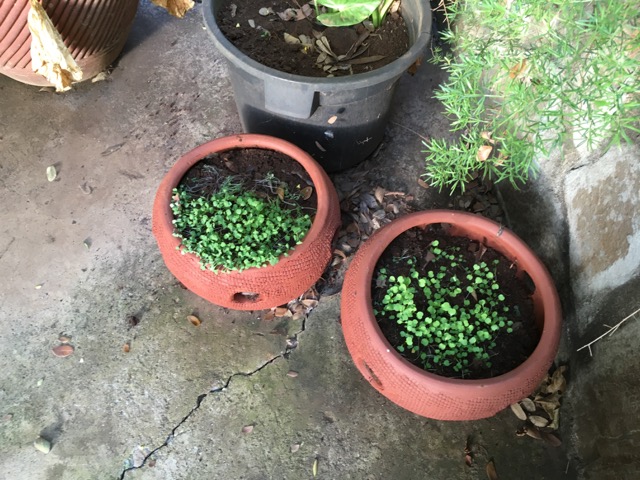
Arugula (planted by my gardening mom in January to get me started)

  • The Joshua Foundation team has a Sunday afternoon time of worship. We’ve been meaning to participate at some point, but we finally were able to attend for the first time this past Sunday. It’s a small, intimate gathering with Vineyard style worship and prayer and some teaching. Though we are not on the team, we are welcome, if not completely in our element. We were grateful to receive prayer and share some scripture and to see how we might come to know our neighbors better.
  • David played very well with neighbor Josiah almost the whole afternoon on Saturday (they’ve had rough moments in the past, but are learning to co-exist).
  • I’ve been meaning to invite Josiah’s family over for dinner for ages and we finally managed to get it together this evening after work. We really enjoyed talking with both Simon and Joanna, while their toddler kids ate and played around us. It was really fascinating to talk with Simon, a team pastor, about the complexities of being part of his Ugandan land-owning family system, amongst many other things.
  • And finally, David found his old hedgehog again this morning, before we left for school. These moments seem like little signs that things are relaxing and settling.

hedgehog compan

I recall that when we left Burundi and spent a week in mission debriefing, we were taught that in moments of big transition (like moving countries) a family tends to contract. There just isn’t the capacity to really cope with relating to too many people and new things. One’s bandwidth is limited, in terms of physical and emotional energy. I’ve felt the need and desire to connect with more people, but I also have not felt the capacity to go out too far, and I have just kept repeating to myself, “Patience.” Now, there really has been a shift of sorts and I’m glad for it. There is the capacity to expand the circle again. Even while my nose was running, and eyes were streaming from the head cold, I really felt a great deal of contentment all week.

pre-dawn class bus
There were a few interesting events on this normal week, which I’ll just throw in. On Sunday morning, we left the house at 5:30 am to take Oren to school to start his “Activities Week” class camping trip in the Usambara mountains. They will be staying in tents, doing day-hikes and doing some service in the local community. Oren was anxious about going – he has some bad memories of tough things he had to do with the boy scouts I guess. So, we are praying that he will be open to the good aspects of this trip. David also has a shorter, 2-night camp out with his class from Wednesday to Friday. It’s not easy for the kids to be away from home, but we hope that they will come to see these as precious memories and experiences, the kinds of field trips you could never do in public school in the US.

After dropping off Oren, we came home and got ready for church, where Paul preached a sermon. Sadly, I was not able to listen, since I was teaching Sunday school yesterday. I know that he explored the episode in John 9, where Jesus heals a man born blind. It’s an amazing story, in which the gospel has a transformative effect on one man’s life—and you’d think everyone would be happy about it. Instead, we find that the gospel badly disrupts everyone else – the neighbors, the parents, the religious leaders – and people feel threatened and undone. No one likes this transformation. But that’s what the gospel does. Personal salvation, if it’s genuine, will disrupt all the other cultural norms and structures, and the saved, healed person may end up with more enemies than before.

One other sweet and serendipitous gift was given to me on Thursday. The woman who hosted our bible study will be moving to a new house within Arusha shortly, and packing is always a stressful process. I really didn’t have anything to do that afternoon, since I now work 3 days a week, and so it was easy to stay and be her packing cheerleader. Along the way, she treated me to lunch at her dining table, together with her cook and her gardener. We ate delicious pumpkin greens, cooked with peanut butter, and had some good conversation in Swahili. All three are delightful people and the conversation was very interesting. I realized that I can’t say or understand everything, but I can manage a fair bit, and it’s times of practice like that which are helping my language ability grow and open, like a bud that is getting ready to bloom.
passionfruit over the mango

Tuesday, January 16, 2018

Until I entered the sanctuary of God...

This week, it’s Rebecca writing the blog on behalf of our family. After a wonderful time on the coast, Paul gave my parents a final good weekend here in Arusha. Then he needed to single-handedly take over the job of transitioning our children back into school last week, after a month-long holiday. He reported that he nearly had a mutiny every morning as he tried to wake the kids before dawn in order to get them to the bus on time. Aside from a rough time getting back into the regular schedule though, things went fairly well for him and the kids.
David and Oren making cookies with Gramma Jean

Meanwhile, I had two days of transition back to the office before I needed to leave town to do something completely different from our normal Arusha routine. Back when we worked with MCC in Burundi, I became involved in a movement for Christian reconciliation in the region. It was called the Great Lakes Initiative (GLI), and it brought together “restless” Christian leaders from very different walks of life and gave them opportunity for theological reflection around the idea that reconciliation is the mission of God. It was one of the only venues we ever saw in that region in which both Catholic and Protestant leaders were willing to participate – and even pray – together. And alongside various bishops and other Protestant church leaders, Christian development workers and various community members came to tell their stories and learn from each other during an annual Institute. In between those gatherings, we began to develop a very active network in-country in Burundi. Here is a blog I wrote, right after my last opportunity to participate in the GLI Institute in 2014, if you want more details.

with fellow worship facilitator Acher
I had served on the Board of the GLI for several years until 2014, and when I returned to the continent, the GLI director Prof. Wilfred Mlay contacted me to see if I could become involved again. In fact, he and his wife live just 2 hours from us in Moshi in their retirement home, and we were able to visit them a few months ago. I was very thankful that my new MCC leaders saw the value in my continued participation and allowed me to go to Kampala, Uganda for the Institute. I was invited as a worship facilitator and a speaker on the final day.  Even before I left for Uganda, I had been in contact several times with the two other worship facilitators, one of whom was my pastor in Burundi, Acher Niyonizigiye. The other woman, Josephine Munyeli, and I had worked together on worship for 3 previous GLI Institutes and wrote the GLI theme song together. It was already wonderful and refreshing to be in contact with these old friends.

Our travel to Kampala went reasonably well, and put me in touch with a number of other participants coming from Tanzania. When we arrived, there was time to take some rest and then to begin to catch up with other old friends, including Emmanuel Ndikumana. He had led the IFES (Intervarsity) group in Burundi and then founded our Bujumbura church. Together, we had served as church elders and also worked very hard to bring Protestant leaders in Burundi together to have a positive impact on the formation of a legitimate Truth and Reconciliation Commission in Burundi. It was a great treasure to sense that the bonds formed during that hard work still remain. This was part of recalling a key component of the GLI. As we join God in his mission of reconciliation, we find that fellow travelers become family, and we become a “new we.”

The GLI Institute began on Sunday, but slowly. As participants trickled in, we had a small worship service on Sunday morning in the Ggaba seminary chapel. Again I was grateful that our venue was a place for the training of priests, with such a beautiful and awe-inspiring worship space. Mama Faith Mlay’s message to our small group will challenge me for a long time to come, as the starting point for reconciliation.

Are you willing to worship a God who refuses to be on your side?

Faith recalled the story of Joshua, a faithful and determined leader, who followed the instructions of God carefully. He had circumcised a new generation of Israelites and was preparing to attack Jericho, when he suddenly came across an unknown armed man (Joshua 5:13-15). Like any brave soldier would, he confronted the man and asked, “Whose side are you on? Are you for us or for our enemies?” He was totally unprepared for the answer:

“Neither,” he replied, “but as the commander of the Lord’s army I have come.” This angel demolished all of Joshua’s fixed categories of “us” and “them,” “our side – i.e. those who have truly understood the way of God” and “Their (godless, heathen and heretical) side.” In fact, there seemed to be a more important question implied here: Are you on the Lord’s side? And do you even know what that means?

Joshua had the presence of mind to do the right thing. He fell on his face in awe. And then he remembered to ask an important question. “What message does God have for us?” The angel confirmed that worship is the first and best response to understanding God’s perspective and God’s side: “Take off your shoes, for the place where you are standing is holy ground.”

Since I’m from a country where everything is polarized, politicized, tribal and divided, it’s really difficult to resist the temptation of thinking in terms of “us” and “them.” I have a political perspective and I strongly feel drawn to it. And yet, who am I to ask God to bless “my side?” On the other hand, when I am able to really worship this God who won’t be on my side, when I pledge allegiance to the Lamb, then suddenly the strategy looks like sacrifice and victory looks like death on a cross. I don’t find the achievement of my agenda in any straightforward way. It’s not easy to let God be God.

The Institute began in earnest with an opening time of worship and an address from a faculty member at Duke Divinity School (one of the GLI partners). He recalled a critical moment in the history of the church, when Bishop Ambrose confronted two different emperors who were trying to coopt the church for their political ends. The church past has much to teach the church of the present.

Where are we headed? The New Creation

On Monday morning, we began our journey of theological reflection by recognizing that God has always been working on reconciling all things to himself. In God, another world becomes possible. Fr. Emmanuel Katongole, a Ugandan priest and academic, brought to life the story of Esther. It seemed that she was brought to a position of influence by chance, but in fact she had been prepared by God and was willing to listen to godly people speaking into her life. “Who knows, but that you have come to royal position for such a time as this?” With prayer from the community, Esther is able to surrender to the will of God (“if I perish, I perish”) and confront the powers around her in order to change the outcome of events. Sadly, in the case of Esther, the Jews play by the same rulebook as Haman’s people who were determined to exterminate them. Fr. Katongole pointed out that God’s new creation involves more imaginative ways to open up new creation and include an expanding “we.”

We heard the inspiring witness of Dr. David and Dr. Kaswera Kasale. He resigned from a safe, well-paid position as head of a theological college in Nairobi to return to their home community in the Democratic Republic of Congo with 3 school-aged children. There, against all sense, they have established a Christian university and are revealing new creation on the outskirts of power.

What’s going on? Lament

Our second day compelled us to look critically at the world we live in, and to “see things which can only be seen with eyes that have cried.” God is bringing about new creation, but our reality falls far short. During worship, our devotional speaker Marion described in graphic terms some of the cases she is lamenting for in her home country of Kenya, and asked, “Does Jesus really care?” In worship we responded by calling out to God to see us: “Angalia, Baba!”

Father Jacob, a scholar from DRC, unpacked the short prophetic book of Obadiah with two very different imaginative readings. On the one hand, we see the struggle between Edom and Israel as a family struggle between two brothers, Esau and Jacob. As “Jacob” is being destroyed by Babylon and taken into exile, “Esau” just stands by to watch, to mock and even to profit from Jacob’s defeat. How often do we just stand on the sidelines while our brothers and sisters are suffering from war and displacement? On the other hand, Fr. Jacob pointed out that perhaps the nation of Israel, through the prophet Obadiah, is really just looking for a scapegoat to explain the suffering, blaming their problems on a nearby tribe, Edom, whom they already distrusted. He reminded us that “tribes exist, but ideology about tribes is constructed and imposed upon us.” As we lament, we need to also examine our ideologies and make sure we are not blaming others for our suffering, simply because of the dogma we’ve learned. We ended the day in worship, led by a group of Ugandan Catholics, crying out in many languages for our various countries.
Models of the torture tree

What does hope look like? Pilgrimage

On Wednesday morning, we left the seminary to take buses on a pilgrimage. We visited the site where 45 young Ugandan men (22 Catholics and 23 Anglicans) were martyred in 1886. Read more about the Uganda Martyrs here. Most of these young men were pages or officials, serving in the court of the Baganda King Mwanga II. Although his father had tolerated the conversion of some Baganda people, King Mwanga became increasingly upset with the new way of life he saw among the Christian converts. The final straw came when he heard them praying the Lord’s Prayer: “Our Father in heaven, hallowed be your name. Your kingdom come…” 

King Mwanga heard a threat to his own power with this coming Kingdom and soon the young men were forced to declare their allegiance, either to the King or to Christ. All but three refused to renounce their faith and they were sentenced to death by burning. They walked, or were dragged on their backs, to the execution site Namugongo. They spent a week in chains, enduring torture, hunger and thirst, but also in prayer, refusing to recant. Finally, those who had lived through the week were bound in reed mats and burned alive. They died, singing and encouraging one another. As it turned out, the blood of the martyrs was the seed of the church. Even their chief executioner was converted by the testimony of the young men he killed. By the time missionaries were able to return to the area several years later, they found 1500 Christians waiting for instruction.

An Anglican church and museum has been built at the execution site, around the actual torture tree, and just up the hill from the spring where the executioners washed blood from their weapons. It includes an assortment of grisly sculptures, depicting the type of torture and inhumane treatment those Christian martyrs endured. Every facial expression asks the question of the observer: “faced with this, would you remain true to Jesus?” And on the other side we find a warning: Fear turns us into animals and allows us to treat other human beings the way those executioners tortured the young men.
Violette and new friend Sr Dona

It was a sobering day, and when we returned to Ggaba seminary we had some time to rest before reconvening. Dr. Celestin Musekura, a pastor from Rwanda, challenged us on what it looks like to have real Christian hope. He drew inspiration from 1 Peter 1:3-13, as Peter addresses a Christian community that has suffered poverty, displacement and persecution. And he asked a series of penetrating questions about “how to know if I am living in hope.”
  1. Do I have an unquenchable joy? (v 6)
  2. Do I value character growth more than feeling good? (v 7)
  3. Am I doubting or deepening in my love for Jesus? (v 8 – 9)
  4. Do I see the privilege of living in my time in history? (v 10 – 12)
  5. Do I keep my eyes on the Prize? (v 13)

These questions challenge my faith even now. Am I motivated by joy or by fear? Do I have boldness? Am I seeking God’s direction in this time and giving thanks for it? Celestin was a great speaker, having literally risked his life to bring hope to people in refugee camps in Darfur, South Sudan and on the border with Burundi.

What kind of leadership do we need?

Violette and Ken responding to questions on leadership
On Thursday morning, two mature Christian leaders spoke to us of their life journeys and the kind of leadership they have been converted to. Violette Nyirarukundo was involved as an advisor of the MCC program in Rwanda, and I have sat at her feet in past years and learned much. She is a trained Christian counselor and spoke about overcoming the anger and resistance in her own heart, following the genocide in her country. She reminded us that “our suffering is precious. Don’t waste it. It can become a very important tool for God’s healing in the lives of others.”

Ken Butigen teaches Christian nonviolent responses to conflict. He encouraged us in the practical mobilization of a community to seek change nonviolently, pointing out that it actually works 2 times better than violent campaigns for change, according to rigorous research. He stressed the need for training and discipline in nonviolent action. And he encouraged Christian leaders to share the gospel of nonviolence with others. Interestingly, many pastors did not seem to be familiar with the link between the gospel and nonviolence, but were hungry to learn more. Most evangelical teaching focuses on personal salvation and neglects the way that Jesus actually lived. I personally think there is a growing edge in theological training around the person and practice of Jesus and how it offers us a new approach to living a holistic Christian life. And this relates directly to being a good Christian leader and a shepherd of our people.

Why me? Why bother? Spirituality for the long-haul

Kenyans leading worship
After a joyful time of worship, led by a team from South Sudan, I had been asked to speak on the final morning of our gathering. I really don’t think I’m the best person to speak on the topic of spirituality for the long-haul, but I guess I’m qualified in the sense that I’m still struggling but also still standing. I decided to explore Psalm 73 and reimagine it. Here is my new version of Psalm 73, after a fair bit of study of the text, a version which speaks to me, in my situation, today. In fact, I found I had to return to the topic of lament. I lamented the situation in which I find myself, what has happened in Burundi where I used to live and what has happened in my own nation. I lamented the fact that God has allowed the wrong people to enjoy the shalom that should go to God’s people. I talked about the anger and frustration, and the risk of finding our feet slipping when faced with the world we live in.

The only real corrective I’ve found is what Asaph also found: “I entered the sanctuary of God.” I urged my fellow Christian leaders to take a time of Sabbath. We need to gain God’s perspective on what we’re facing (not just endlessly rehearse our own side of the story). In Sabbath rest, we find solid ground, rest, strength, the ability to roar in anger and still feel God holding us firmly by the right hand. We receive counsel from God, which we couldn’t dream up on our own. And we, by God’s grace, might still have a story to tell of God’s goodness at the end of our days, as the martyrs did, rather than a story of bitter betrayal.

We ended the week with a time of joyful celebration in worship. Lots of different people participated and brought their musical gifts to bear. We received a charge from Dr. Musekura, and we ended by singing that “God is so good,” in at least 10 different languages.

In between all these highlights of content, I can’t even begin to recount the many intense 30 minute conversations with old and new friends, the meetings with colleagues from Tanzania, good times of connection with MCC staff from around the region, and even connections with Christian leaders from Baltimore, whom I might see again in the future. God was truly very good to me over this past week, and I am thankful.

New friends from Uganda
My return journey home was smooth, and I was very, very happy to see Paul and my sons again. It was especially sweet to receive all the snuggles from my boys and to have time to catch up together. Oren and David even agreed to take a walk with me when we got home, to share all that has been going on. And now, we are at the beginning of our first really normal week of 2018. I am grateful, and I am ready to see and understand the privilege of living at this time and place in history, and to find out what God has in mind for me and my family here.


Monday, January 8, 2018

Tales Among the Mangroves


It is a rainy Saturday morning here in Arusha as I start this tale. Officially our Christmas holiday ended this past Wednesday and Rebecca and I returned to work. The children go back to school on Tuesday. Rebecca just left town for a week, but Dave and Jean Sack are here until tomorrow evening when they will leave as well. It is a good moment to reflect on the past week of activities and our all too short, but deeply satisfying 6 day vacation trip over the break.

We have been planning since October to take a trip to the coast over the holidays. The Tanzania coast, like most of East Africa is one long coral reef and offers many opportunities for snorkeling and other beach related activities. Our family had been to Zanzibar once during our time in Burundi, and we would have loved to return there, but decided that the money saved by driving to the Tanzania coast across from the Zanzibar archipeligo would be a reasonable substitute. It did prove to be so.

Since there were 6 of us traveling, the grandparents--Dave and Jean Sack, Rebecca and I, and the two boys, we needed to find a bigger vehicle than the Harrier we are driving here. Forunately MCC has a large landrover which we borrowed for the 600 km trip. What it lacked in comfort, it made up for in space, power, and fuel efficiency!

We left the Wednesday after Christmas and planned to do the trip in 2 days with an overnight in a village North of Moshi (on the way), close to Mt. Kilamanjaro. This was made possible by a professional colleague of Dave's who invited us to her family home for an overnight. We got a start from Arusha in the early afternoon and arrived at a rendez-vous point just past Moshi to follow someone to the actual address of our overnight stay since it was pretty far off-road up toward Kilamanjaro.

Kilmanjaro from the South
We arrived well after dark and I was glad we had a landrover because some of the driving required a very high clearance vehicle with alot of power. We had a nice dinner with Dave's colleague, Dr. Fausta, and her parents. We woke the next morning to finally get a view of our surroundings and found ourselves on a very quaint farm about half way up Mt. Kilamanjaro! --With a good view of the summit. (Very close to the start of the 'Coca-cola route for those who know the region.) We took a short morning hike to see the mountain better, then loaded up again and drove back down the rough terrain and onto the main road  heading east for our 8 hour journey to the coast. The addition of the mountain visit was an unexpected, pleasant surprise.

lunch break on the road
It is important to set the tone of this trip by framing it around our primary activity while driving. Because we do many long trips to and from places in Arusha as a family, we have taken to listening to audio-books whenever we are in the car. We finished the entire Harry Potter series several weeks ago and began listening to Tolkein's 'Fellowship of the Ring'. After listening to Harry Potter, which jumps from climax to climax fairly continuously, it is a noticable transition to the slower paced writing of Tolkein that puts great time and detail into the long process of travel. We spent about 10 hours on the road that day listening to the slow progress of Frodo Baggins and company leaving the shire and after many, many days, multiple recountings in tales, and songs, of the history of Middle Earth, -- eventually arriving in Rivendale.

The mindset of travel as an end in itself and not just a means seems to be part of the genius of Tolkeins story. The encounters with strangers and the telling of tales and singing of songs as a regular and anticipated activity of arriving at an evening rest point in the book also became part of the logic of our own  journey. This was particularly true because WE DID NOT TRAVEL WITH OUR COMPUTERS or with any easy way to connect to the internet. (We did have our cell phones for emergencies but no data.) This became a true blessing, and the anticipation of meeting new people and hearing stories from other places became an intriguing part of our own journey now that we were not 'wired' with all the latest current events and distractions.

We arrived, after a long day driving East through fairly dry savannah, but with the Usambara mountain range just to our north. The landrover is uncomfortable and we were fairly exhausted when we pulled in to the Peponi Beach Resort just north of the town Pangani. (The last 40 kilometers were on a washboard dirt road too.)

We were received warmly at reception and shown to our 'bandas which are thatched roof cottages just off the beach. It had the feel of a campsite in a way, because there was nothing paved between cottages, restaurant, bar, pool, and ocean front. It was all sand or packed dirt paths through groves of trees and small lawns and gardens. There were monkeys in the trees and we could hear bush babies calling at night. It was very charming in Swahili coast style. The weather was hot during the day, but cool with an ocean breeze that blew through our windows and quietly rustled the mosquito net canopies over our beds.

Mangroves at high tide
David was up at the crack of dawn the next morning and down at the beach catching hermit crabs and looking for seashells. We got up and had breakfast then went down to the beach as well. It is quite remarkable to see the beach at low tide because the water recedes nearly a kilometer, leaving acres of sand and coral tidal pools full of star fish, anemones, sea urchins and small tropical fish to explore. There were also a number of groves of mangrove trees sticking out of the shallow water which offered an opportunity to explore for fish, crabs, and birds.

We also discovered that several families we had met in Arusha were there as well and we had a chance to visit with them and hear more about life in Tanzania. David enjoyed seeing some of his mates from Sunday school who helped him collect shells.

On the second day though, David met a particularly intersting boy of 11 named Malik who was not from Arusha. Malik had both the appearance and swagger of a young Captain Jack Sparrow, (complete with dagger thrust in his belt).  He had the comfort in the culture of a Rudyard Kipling's 'Kim'. David spent the day with him climbing through mangroves, and exploring tidal pools, and collecting crabs. Oren also seemed to enjoy him greatly as he was closer to Oren in age and shared his sense of humor.

Malik told us that although they had a house up the coast in Kenya, he and his family usually stayed in Northwest Territories in Canada where they lived on a houseboat and he canoed to his bustop when the lake was not frozen over. His story piqued our curiosity and eventually we did find his parents who had parked their landrover at one of the available beachside campsites and had pitched a tent on its roof.

Rebecca found in one of the first conversations with F. (Malik's dad) that we had an interesting '1st degree of separation' connection. He had been part of the UN group of experts working in DRC and predecessor of Michael S., our dear friend and colleague whom he had recruited and hired to replace him in that role. Michael S. some of you know, worked with us at MCC in Rwanda/Burundi/Eastern DRC. He left MCC shortly after we did to take the job at the UN in DRC. He and another UN worker were tragically murdered in Kaasai last March while investigating anti-govt. activity in that region. (The investigation into this goes on.)

F. and his wife H. (who is an epidemiologist) were frankly fascinating people with whom we felt a deep connection in a very short time. In the evenings in the days that followed we looked forward to sitting with them under the open air patios along the beach, usually swinging gently in the hanging platform beds watching the tide go out. It had the feel of the gatherings described in The Fellowship of the Rings after a long day of activities with stories deepening in intrigue each night.

I was partcularly taken by the story of the summer camp they ran at their lake the previous year called "A Dangerous Camp for Kids"--as a corrective to the hyperprotection children often experience at home. The camp was set up as a one week adventure in which the kids arrive on day 1 to find a number of barrels, scrap wood, and power tools by the shore. They are told there has been a zombie apocalypse and they need to build a raft to get to a nearby island, then take the raft apart and make a fortress where they will camp for the week. During the week they do numerous activities on the island including nature walks, rope courses, and othe challenges. Every night F. led them in a process of reflection on the days activity, particularly the times of conflict and conflict resolution. (That is his area of expertise.) On the last day they wee taken out fishing only to discover that zombies (their parents dressed up) have taken over the fort. They must break into a house (taught technique of lock picking and breaking padlocks), find plans for an antitode, concoct it, and get back to the island to save all the zombies. It sounded really awesome. He described it like adult 'Outward Bound' adventures but with more intentional time to reflect and learn from situations where they faced conflict.

The days were replete with activities--snorkeling and beach combing chief among them, but also included playing board games, reading, watercoloring, and sleeping.

On our third day there we took a trip on a dhow (traditional sail boat) about 2 kilometers offshore for some amazing coral reef snorkeling. Despite the fact we were so far from land, the water was only about 12 feet deep around the reef. David, Oren, Rebecca, and I all went out snorkeling for a couple hours around the boat while Dave and Jean watched from on board. The view was beautiful and we saw just about everything one could imagine, octopus, moray eel, countless tropical fish including a venomous lion fish guarding a piece of coral. One of the sublime features where we snorkeled was a "Finding Nemo" style 'drop-off' where the reefed ended and the bottom vanished dropping hundreds of feet almost straight down. It produced some anxiety of seeing large shadowy forms in the depths below.

When we had had our fill of snorkeling, we got back on the boat and were taken to a pure white sandbar also well away from any coastline. There they set up a tarp and we had a lunch that was prepared for us. We swam around the sandbar after lunch and within a couple hours it began to disappear under the tide. We packed everything quickly and were off the bar as it disappeared under the water in the high tide. We sailed about an hour back to the hotel/campsite. It was an awesome day.

Dave Sack in the surf
New Years was another highlight. The Peponi resort staff prepared a big bonfire on the beach. We sat around on the swinging beds with our new friends and shared stories. I know other expats. have probably had the experience of making deep friendships quickly--probably a survival mechanism. But there is also that experience, when constantly remaking one's social network, of meeting total strangers that seem to be long lost friends-- an experience of a deep spirtual connection. These occurences are few and far between, but Rebecca still have friends all over the world with whom we have continue to feel a deep bond, eventhough we rarely see each other. A reunion, even years later, can feel like no time has past at all. That is how it felt to spend time with Malik's family.

Our conversations were rarely interrupted by the kids who were having a great time collecting hermit crabs on the beach by flashlight and had coralled about 100 of them in a small hole they dug in the sand. (they let them go later.) Some were enormous. Around midnight we noticed that Oren and Malik had gone over to the beachside bar and Malik was dancing on the bar with the resort proprietor. (I did mention that he had the charisma of an 11 year old Captain Jack Sparrow.) When his dad went to subdue him we noticed several minutes later that he had instead been recruited to join Malik in the bar top revelry. As midnight approach we all began dancing to disco oldies to welcome in the New Year, then promptly went to bed shortly after midnight.

On our last night, again following the formula of the 'Fellowship of the Rings' we shared a bottle of wine at dinner with F. and H. while Malik and the boys ran aroud on the beach. The tales went deeper still, and H. told us about F.s last trip to Somalia where he was doing disaster management at a refugee camp and was kidnapped by Somali pirates. He shared with us the story of his capture and release, (made possible only because of his many local contacts in Somalia.) We talked into the night about what was important in life and agreed to be in touch in the future. I went to bed with a sense of gratitude for the good things we have and a renewed sense of wonder.

The next morning we packed up and began the 10+ hour trip to Arusha. We again listened to The Fellowship of the Ring and the continuing journey from Rivendale to Mordor. The length of the journey and the excellent voice of the narrator (Rob Inglis), who made up tunes and sung the many songs and poems along the journey gave the otherwise exhausting trip, a deeper sense of purpose.

I have to say that I do not think Tolkein's trilogy would have succeeded at all if it was written in the past decade. We live in such a fast-paced society. A book that does not include the adjective "Riveting" as a descriptor would struggle to gain a readership. Tolkein is anything but! He demands that we take time to read about every long tedious day, to see the sights, smell the smells, meet the people along the way and hear their stories. He even demands us to follow false starts, turn back; that we learn the geography of Middlearth, including human and elven names for every locale and region--as well as its history. I realize that for me, I have generally seen the journey as a necessary evil, and distraction as the main activity along the way, to relieve the tedium. I am certainly not alone in that. But I think it is a loss.

This is actually the second time I wrote this blog and it is now Monday morning. I had written it once and with a computer glitch it vanished (eventhoug it said it was saved.)  We got back to work after traveling all day last Wednesday, on Thursday morning. Dave and Jean helped with childcare as the kids don't go back to school until this Tuesday.

On Saturday Rebecca left for Uganda for a week, and on Sunday Dave and Jean left for Dar Es Salaam and then back to Baltimore. The holidays are over, but I have many memories treasured in my heart from this one to carry me through to summer at  least.